
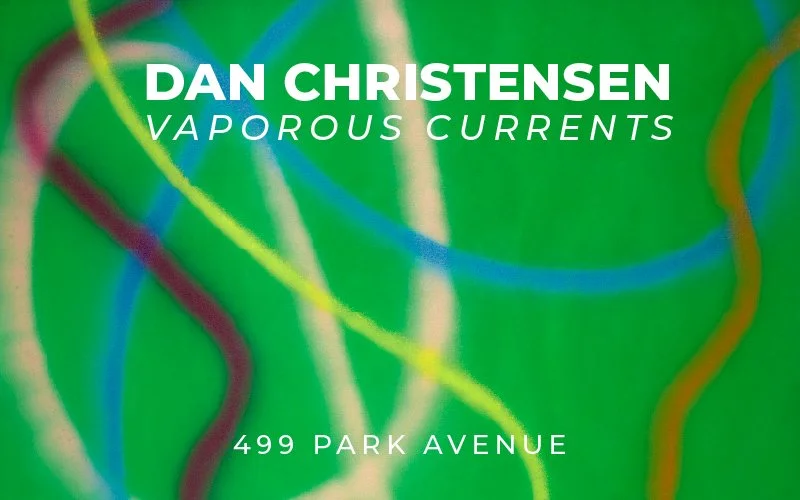
The Lobby Gallery at 499 Park Avenue presents Vaporous Currents, an exhibition of paintings by Dan Christensen through September 2027. Produced in partnership with Berry Campbell Gallery, the exhibition is accompanied by a brochure featuring an essay by art historian Alex Grimley, PhD. Located at Park Avenue and 59th st., the exhibition is open to the public Monday - Friday from 9 AM - 5 PM.
Vaporous Currents: Dan Christensen’s Spray Paintings
by Alex Grimley
“Dan Christensen is one of the best of the younger abstract painters,” Hilton Kramer, the art critic for the New York Times announced in October 1972, on occasion of the artist’s fifth solo show in New York in as many years. Christensen, then 30 years old, was enjoying a surge of success and recognition for his innovative, large-scale canvases which charged sprayed color with an electric force across the pictorial field. During the closing years of the 1960s and the earliest years of the 1970s, as artists of his generation explored color’s expressive possibilities, Christensen’s paintings gave this pursuit an especially lyrical and exuberant expression.
In 1965, after graduating from the Kansas City Art Institute and completing a fellowship at Indiana University, Christensen moved to New York City and plunged into the contemporary art scene. The first series of paintings he completed after arriving in the city, comprised of darkly colored rectangular bars arranged in a loosely defined grid, were characteristic of the decade’s hard-edged, geometric art. Combining formal rigor with aesthetic intuition, these pictures secured his inclusion in the 1967 Whitney Annual Exhibition. Later that year, the Museum of Modern Art opened a major retrospective of Abstract Expressionist artist Jackson Pollock, whose expansive compositions, dense with tangles of looping lines, made a deep impression on him. Less than a year later, seeking to synthesize Pollock’s distinctive drawing with his own commitment to brilliant color, Christensen began work on the series of paintings on display in this exhibition.
Buoyant, vaporous, and effervescent, Christensen’s sprayed paintings of 1967–68 were innovative both for their chromatic effects and for the means by which the artist achieved them. Though he was not the first abstract painter to use an industrial spray gun, his application of the tool for drawing transformed it into an instrument of color and gesture. In the electric Red-Red (1968), radiant lines of color are woven through one another, hazily glowing like neon against the painting’s flame-red surface, an effect heightened by the contrasting sheens of the two elements. Christensen’s sprayed lines sparkle and shimmer across the matte ground, their glossy finish intensifying the work’s luminous effect. Red-Red was illustrated as a half-page reproduction in a May 1969 article on contemporary art in Time magazine (one of the most widely read publications in America at that time), where a brief comment on the work elaborated on its title: “[Christensen] considers titles irrelevant. Red-Red was called that because he wanted to make a picture redder and more intense than any he had made before,” the author explained, before dryly concluding: “He has done so.”
Though Christensen minimized the importance of his paintings’ titles, West Wind (1968) seems an apt description of the visual sensations the work evokes. In contrast to the play of colored lines suspended upon uniform grounds in Red-Red and the grass green Pollux (1968), West Wind introduces diffuse mists of color that seem to drift and disperse in the wake of the windswept ribbons that billow across the surface. Spectral brushwork, visible as traces beneath the zones of gauzy color, read like currents moving through those atmospheric areas. In 1983, Christensen moved to East Hampton, where he continued to develop new possibilities for the spray gun, using it to define shapes rather than lines alone. Ovals, circles, and ellipses recur throughout his paintings of the late 1980s and early ‘90s. In Juneau (1991), two luminous and ethereal orbs placed side by side fill the canvas. At every stage of his career, Christensen found inventive uses for the color white, and in this painting the center of each orb registers not as negative space but as blindingly bright light, like the midday sun on a clear day. Hazily defined halos issue from each orb, blending concentric rings of warm gold, blush pink, and frosty white that gradually dissolve into one another and merge along the central axis. The breadth and sustained achievement of Christensen’s career was recognized in a number of early 2000s museum retrospectives, including one at the Parrish Art Museum on Long Island’s East End, where he was based.
Throughout his career, Christensen continually devised new ways of organizing line, shape, and gesture. This inventiveness was informed by a commitment to abstraction and to color’s affective potential that remained constant even as his formal vocabulary changed. Separated by two decades, his early and late sprays reveal the balance between rigor and play that characterizes Christensen’s art. Though his paintings are carefully structured, their underlying order provides a framework for experimentation and surprise, a dynamic that contributes to the immediacy of their appeal. The sweeping ribbons of his early paintings and the luminous forms of his later work thus belong to the same sustained pursuit—to expand the emotional and expressive possibilities of color.
Alex Grimley, PhD, is an independent art historian specializing in postwar and contemporary art, particularly Color Field painting. His writing addresses intersections of visual art, criticism, and experimental music.